As healthcare professionals and educators, we’re constantly drowning in a sea of documents. New guidelines, updated policies, essential research papers, training materials….. these complex and often lengthy documents can take time to read and extract the information needed. Synthesising and understanding the document is also another issue in a time when we are all being asked to do more with less. Could Artificial Intelligence (AI) help us? While we often hear about complex AI in diagnostics or administration, what about tools that help with everyday challenge of managing information? Following on from previous episodes of The Educated Guess, let’s explore Notebook LM and its potential to help staff interact with their documents.

The Information Management Challenge in the NHS
Dedicated NHS staff face a significant management challenge. Vast amounts of information, often scattered across disparate systems, paper records, emails and shared drives makes it difficult to get a complete picture. Policies and guidelines are also constantly changing, as is what is considered best practice. This relentless pace of change, combined with an ever-present administrative burden, creates frustration, reduces efficiency, and increases the potential for errors.
What is NotebookLM? (And What it Isn’t)
Generative AI (genAI) tools like ChatGPT are synonymous with the creation of reasonably realistic results from a simple prompt with no requirement for advanced technical skill. NotebookLM is different; it is not a chatbot or a general search engine, but an AI assistant to help you engage with your information in a different way. You upload the files (like PDFs, Google docs, text files), and NotebookLM uses AI (based on Google’s models like Gemini) to understand their content.
You can then:
- Ask it questions about the documents.
- Get summaries of key sections or the whole document
- Generate ideas or drafts based only on the information within those sources.
You are able to upload up to 50 documents per notebook, which makes synthesis of multiple documents quick and easy. Crucially, NotebookLM is designed to keep the AI grounded in the information you provide, often citing the source documents for its responses.
Image Source: Google NotebookLM site
How Could This Help You in the NHS? Practical Use Cases
We aren’t lucky enough to have amazing assistants at our beck and call 24/7 who have read and understood that 50 page policy update or that dense research paper. I think few would stick around with a boss who required this of them. Enter NotebookLM.
- Quick Summaries: Get a concise summary of a new guideline or policy update, new research paper to quickly grasp the main points. It can summarise in voice or text format.
- Instant Answers from Guidelines: Upload a specific clinical guideline and ask targeted questions like “What are the recommended methods of assessment for a UTI in >65 years” or “Which section discusses X drug dosage?”
- Clinical Support/Decision Making: Uploading PGD’s, NICE guidelines, anonymised case histories to quickly summarise key details, identify patterns, or find specific information to inform clinical decisions e.g. drug interactions, contraindications etc.
- Staff Training & Onboarding: Creating a repository of training manuals, FAQs and best practice documents for new staff. NotebookLM can then be used to generate quizzes, summaries or answer specific questions for learners.
- Study Aid: Upload training materials or textbooks to create instant study notes, test your understanding by asking questions and ask it to create exam/MCQ style questions. Interactive mind maps can also be generated and podcasts to help interact with information in a different way, enhancing learning in an academically rigorous way.
- Prepping for Teaching: Upload materials for a session and ask the AI to help you extract key learning points or suggest discussion questions based on the content.
- Research Review: If reviewing multiple papers on a topic, upload them to get a synthesised overview (though critical analysis is still essential!) Can be used to identify gaps in the literature, understand methodologies or summarise a systematic review.
- Quality Improvement and Audit: Uploading audit reports, anonymised incident summaries, and improvement plans to identify recurrent issues, track progress, and synthesize findings for presentations or further action.
The potential lies in saving valuable time spent scanning documents, allowing you to get to the core of the information faster.

Image Source: Created by Google Gemini
Crucial Considerations: Using AI Responsibly and Safely in the NHS
Data Security/Confidentiality: While NotebookLM, as a Google product, employs robust security measures – including Google’s assurance that uploaded content isn’t used to train public AI models – it’s vital for NHS professionals to exercise extreme caution. The NHS handles vast amounts of sensitive, confidential, and patient-identifiable data, governed by strict GDPR guidelines and professional ethics.
Therefore, despite NotebookLM’s general security features, it is imperative that confidential or sensitive information is never uploaded. As a general-use tool, NotebookLM is best suited for non-confidential, publicly available documents like NICE guidelines, published research, internal policies or administrative notes. Always uphold your information governance responsibilities and consult your Trust’s information governance team if you’re uncertain about a document’s sensitivity.
Human Oversight: Always remember that AI tools provide assistance, not final answers. Any output from NotebookLM, especially when informing clinical decisions or policy implementation, must be reviewed and validated by a qualified human professional. It is also not a clinical decision support tool and is not a replacement for human judgement.
Accessibility: If considering implementation of NotebookLM as a Trust, consider whether NotebookLM has features that support accessibility for all staff members.
Learning Curve: While NotebookLM is presented as user-friendly, as with any new tool, there might be a small initial learning curve as people adjust to using it.
Strategic Document Selection: To maximise efficiency and value for staff, upload high-value, relevant documents that staff frequently consult.
Regular engagement: Encourage regular interaction with documents to deepen their understanding of the source materials.
Benefits of Enhanced Information Management
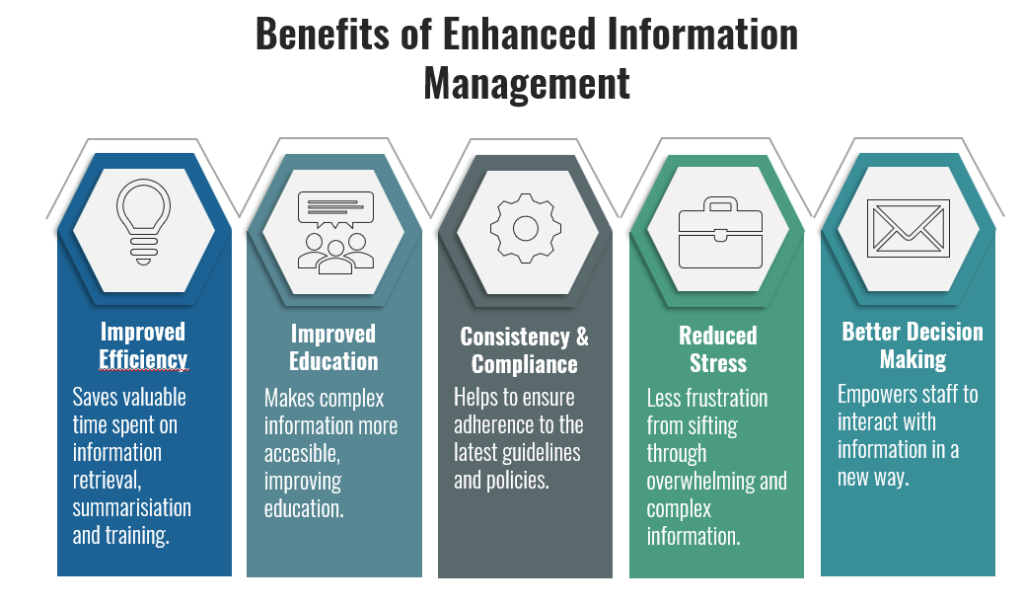
Image Source: Sophie May
Improved efficiency: Saves valuable time spent on information retrieval, summarisation and training, freeing up staff to spend on patient care and core responsibilities.
Enhanced Staff Education & Knowledge Transfer: Making complex information more accessible improves education and continuous professional development.
Consistency & Compliance: Helps ensure adherence to the latest guidelines and policies
Reduced Stress & Burnout: Less frustration from sifting through overwhelming and complex information.
Better Decision Making: Empowers staff to interact with their own data in a new way, improving insights, analysis and synthesis.
Conclusion
NotebookLM offers a powerful transformative tool if used with careful consideration, for addressing the NHS’s information management challenges. I would encourage NHS department’s, trusts and professionals to explore how you could integrate this tool into your workflows, perhaps starting with a trial or pilot in a small area.
AI is poised to revolutionise healthcare by empowering healthcare professionals and improving service delivery. If we don’t learn how to use them, our AI and digital literacy and inefficiencies will be exposed and we risk being “left behind”. AI is a tool, and I firmly believe we need to start thinking of it as such, and develop effective strategies to help reduce workload and improve where we can, whilst keeping human oversight.
Consider how you are currently managing information in your role? Share your thoughts and experiences in the comments!
DISCLAIMER
All views and opinions expressed in this post are solely my own and do not represent any organisation, including my employer. The educational practices and experiences discussed reflect my professional career to date, not exclusively my current role. I am not endorsed by or affiliated with Google nor have I received any form of payment to make this content.
 The Educated Guess
Leave a comment