Imagine this: a student with dyslexia, struggling to keep pace with a lecture, while another student, a visual learner, thrives with interactive simulations. This is the reality of our classrooms – a rich tapestry of learning differences and preferences that often go unaddressed with a one-size-fits-all approach. Time, as with many industries, is our most valuable commodity, especially in healthcare and education. As an educator, I strive to provide an effective and engaging learning experience that optimises time while addressing individual learning differences. This is a complex task when your cohort is 15, but exponentially so with 100. In this episode of The Educated Guess, we’ll explore how AI can help us support greater educational equity for all learners in the classroom. In this post, the use of some specific AI tools is mentioned. I have no affiliation with any of these companies, nor have I received any financial or other incentives to make this content.

Image source: generated by Gemini
Understanding the Learning Process
Learning, at its most basic form, is the acquisition of new knowledge, skills, and behaviours through experience, engagement, and practice. This innate capacity extends beyond humans, observed in animals and increasingly, in machines.
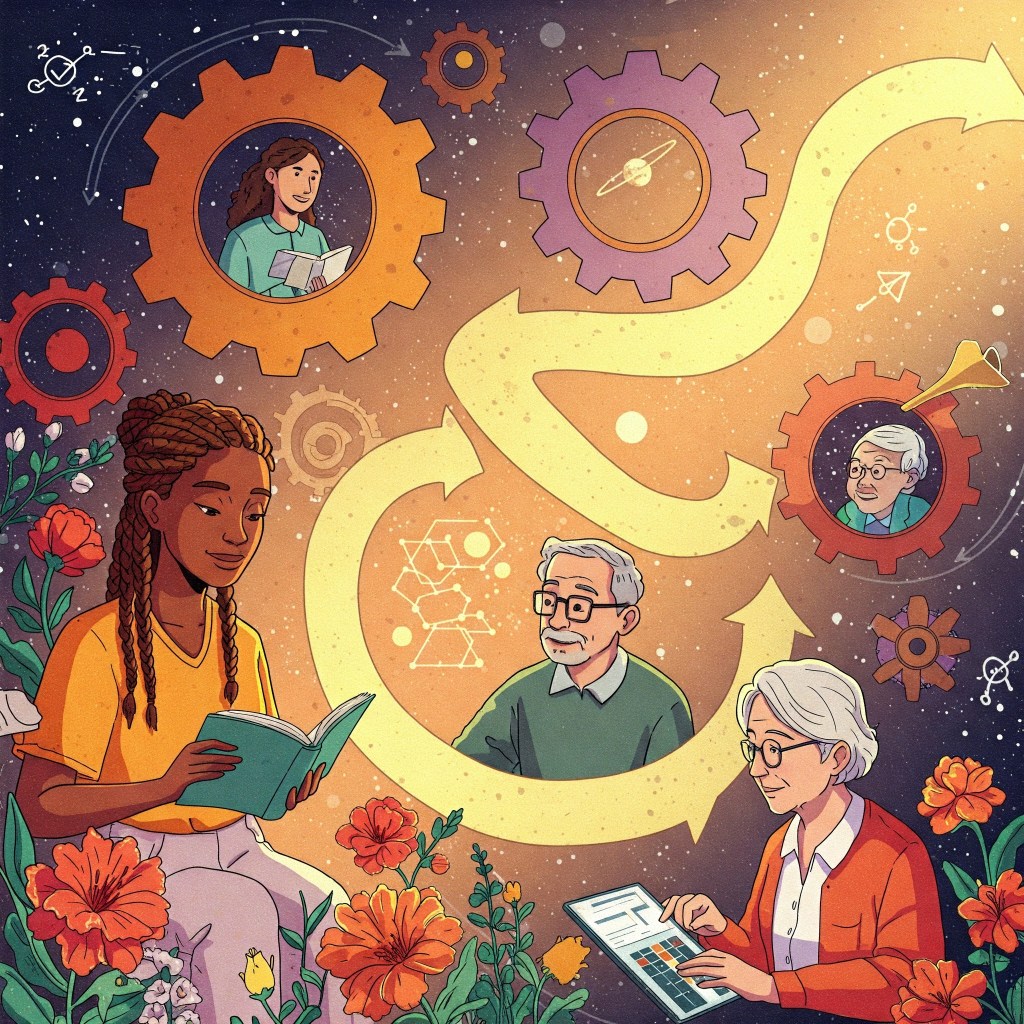
Image source: generated by Gemini
The processes involved in learning are complex and multifaceted and draw upon the insights and research of a variety of academic fields including psychology, neuroscience, cognitive science, social science, and pedagogy. Learning occurs through various mechanisms, including cognitive processes (e.g., observational learning, problem-solving), behavioural processes (e.g., associative learning, operant and classical conditioning)and social processes (e.g., collaborative learning, social learning theory).
While these varied processes share universal elements, such as working memory and information processing, an individual’s approach to learning is shaped by their prior knowledge, experiences, beliefs, genetic predispositions, personality, goals, motivations, and learning styles. These individual learning styles, describe how a person best takes in, understands, expresses, and remembers information, which combine significantly with these other factors to make a learning experience uniquely personal. For example, if I gave two different students the same set of Lego, each would build something entirely different. Their prior experiences, preferences and goals will lead to unique and personalised creations.
Whilst learning styles are one aspect of individual difference and not a singular guide for instruction, research consistently highlights the importance of recognising and addressing diverse learning needs is vital throughout education, spanning clinical training to classroom pedagogy. It is within this spectrum of individual differences that we find neurodiversity.
Understanding Neurodiversity in Education
The term neurodiversity encompasses variations in underlying neurological structures and functioning that impact on our cognitive and physical relationship with the world and consequently, how we learn. Neurodiverse populations, including individuals with conditions such as autism, ADHD, dyslexia, and dyspraxia, may exhibit different strengths and challenges in these learning processes; for example, some may excel in visuospatial learning but struggle with auditory processing. Understanding this neurological variation is crucial for creating learning environments that empower all students to succeed.
Creating an empowering learning environment is essential to ensure all students feel safe, valued, and supported to thrive, across all academic levels. This aligns with Maslow’s hierarchy of needs, a framework which educators can use to improve well-being and engagement.
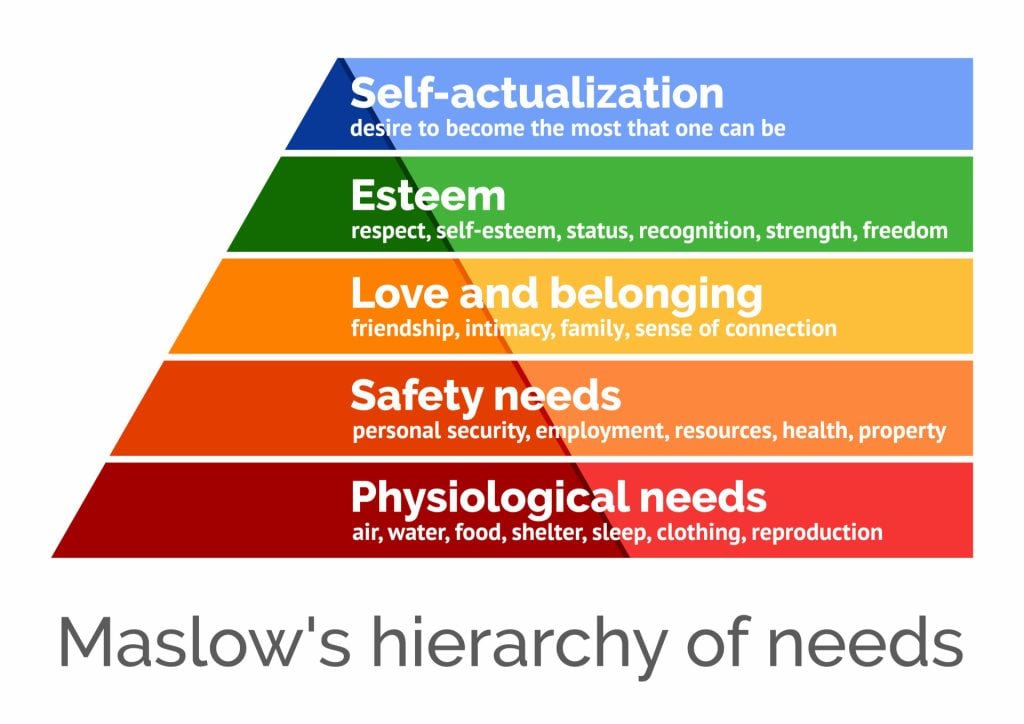
Image source: Simply Psychology available at: https://www.simplypsychology.org/maslow.html
Awareness and diagnosis of neurological variations are increasing, leading to a greater recognition of neurodiversity in educational settings. Historically, people with learning differences would have been excluded, punished, or taken from mainstream education. Today, they are included, rewarded, and achieve.
However, that doesn’t mean that everyone will experience the same level of support, with some having to fight employers and educational institutions for it, often taking months or years. Despite the legal protections offered by the Equality Act, anecdotal evidence suggests that some students still face challenges such as stigma and lack of understanding, highlighting the ongoing need for inclusive practice and cultural change in institutions.
The Role of Digital Tools and AI in Inclusive Education
With the birth of the digital age, we have the ability to efficiently and accurately reach more students psychologically as well as geographically than ever before. With digital tools becoming increasingly accessible, educators can now create individualised learning resources and tools with greater speed and ease than ever before.
Widespread use of virtual learning environments (VLEs) commonly used by universities worldwide provides the portal for distribution of these tools. Despite these significant advances in pedagogical practice, there remain significant disadvantages. Standardised tests and a reliance on lecture formats will not cater to a diverse range of learning styles and needs, however good the educator is with PowerPoint. Large class sizes make it difficult to provide personalised support and can increase disengagement if students are struggling. There is also a pressure to achieve and limited flexibility, which may increase mental health concerns.
However, when implemented thoughtfully, digital tools, and AI in particular, offer unprecedented opportunities for personalisation, such as adaptive learning platforms that adjust to an individual’s pace and understanding, or multimedia resources that cater to different sensory preferences.
From a clinical perspective, it can go further than this, offering ground breaking developments in supporting healthcare professionals. Currently, knowledge tends to be “siloed” into categories, usually associated with medical specialities or anatomical/physiological systems, usually to facilitate efficient and in-depth sharing of knowledge within traditional pedagogical frameworks. This siloed approach can hinder the integration and application of the diverse knowledge domains e.g. ethics, physiology, teamwork, needed for success in practice when complex clinical problems can arise at any time.
The “network model” employs an AI-driven interface that visually represents a learner’s current knowledge as interconnected webs of concepts. Each node contains relevant information and multimedia resources, while AI dynamically weaves these nodes together, adapting the complexity and depth to the learner’s individual stage. This approach embeds collaboration and individualised learning across academic levels. Given the severe pressures on the NHS- such as limited clinical placements and workforce shortages- this model offers a promising bridge between education and practice, enabling more flexible, scalable, and integrated clinical training, encouraging depth and development whatever the academic level. Moreover, by personalising learning and accommodating diverse learner needs, it presents an efficient and cost effective strategy to promote equity and inclusion in the classroom.
Realistically, we have yet to fully realise AI’s potential; however, regardless of individual perspectives on AI, its presence is undeniable. It is imperative that we leverage AI to prioritise inclusive practices, embrace the richness that neurodiversity brings, ensuring that all individuals have the opportunity to learn, thrive and contribute their unique talents.
Practical Applications of AI for Learners
There are a number of ways that digital tools can help bridge gaps for all learners. Examples include:
Autism – Spectrum Disorder (ASD): AI-powered virtual reality environments (e.g., like Bodyswaps.vr) can offer predictable and less overwhelming platforms for practicing social interactions, enhancing understanding of body language and emotions. Wearable devices like Empowered Brain assist in recognising facial cues and social scenarios. As this software is already used widely across the UK, they offer a cost effective model of improvement.
Attention-Deficit/Hyperactivity Disorder (ADHD): AI apps such as Microsoft To Do support task breakdown, reminders and prioritisation. Tools like Focus@Will generate personalised music to improve concentration.
Dyslexia: Text-to-speech and speech-to-text software, along with writing aids like Grammarly, enhance literacy and writing skills. AI can simplify complex texts and summarise information, improving reading comprehension.
AI assistants like Microsoft Co-Pilot and Google Gemini, alongside Augmentative and Alternative Communication (AAC) strategies, supports understanding of vague or complex language, rephrasing information for clarity, organising content for easier retrieval, drafting communications and translating for diverse audiences; however users need guidance to craft effective prompts to maximise these generative AI capabilities. Additionally, AI assistants can help manage routines by integrating calendars, providing visual schedules, reminders and creating study plans that accommodate work and social commitments.
Ensuring Equitable Access
While some AI tools require financial investment, many effective resources are freely available. For example, Google’s Notebook LM offers “AI-powered research assistance, designed to help users understand and work with large amounts of text-based information more efficiently”.
Notebook LM is free to those with a Google account and allows you to upload your own documents (up to 50 per notebook) from various sources and then ask it questions about that specific content. Unlike Google’s search engine that draws information from across the internet to answer questions, Notebook LM’s knowledge base is primarily focused on the documents you provide. It’s answers will not just be generic generated text; it cites the specific places in the uploaded documents it sourced it from. Not only does this help you verify the information and understand its context but allows you to see how and why it has brought up this information, increasing transparency.
Beyond these functions, Notebook LM facilitates discovery of conceptual links, saving reading time and enabling deeper exploration through question generation; things that would have been missed with traditional methods. Its beta podcast tool efficiently converts document collections into a downloadable audio file, offering a novel engagement method. In addition, the podcast offers interaction with the audio, enabling the AI to respond to vocal questions as well as written. Though current voice options are predominantly American, the integration of Google Gemini’s voice capabilities could further enhance this.
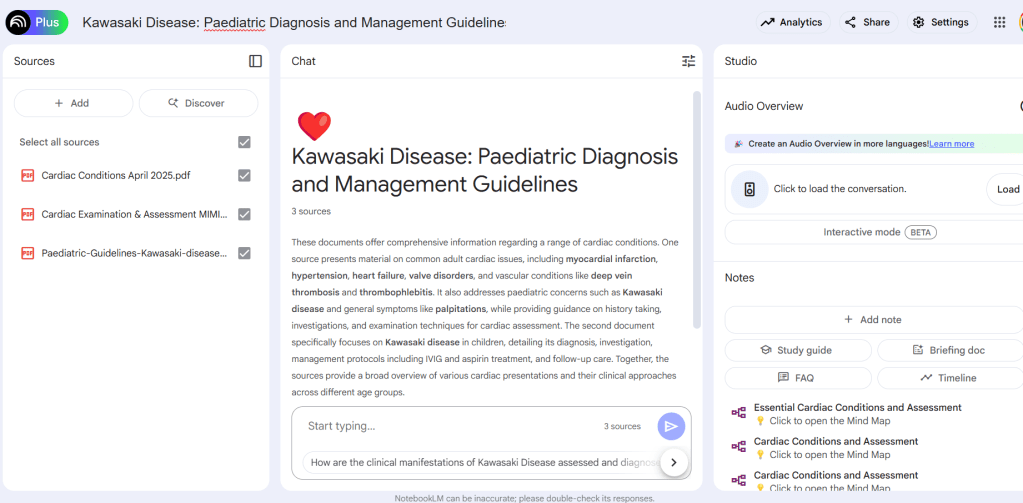
An example of one of my cardiology notebooks with Notebook LM
In my experience, Notebook LM has proven revolutionary for both neurodiverse and neurotypical students, at the post graduate level where managing extensive clinical information is critical. It also aids in the conduction of literature reviews and performing critical appraisals, allowing deeper understanding and analysis whilst maintaining rigorous academic standards.
For those neurodiverse learners, it offers a step closer to the AI powered classrooms that could potentially be in our future, individualising learning in unprecedented ways and levelling the playing field while fostering crucial digital literacy skills valued by the NHS and society. The path towards truly equitable learning environments requires embracing and thoughtful implementation to ensure all individuals maximise their potential for learning and contribute their unique talents.
Disclaimer: All views and opinions expressed in this post are solely my own and do not represent any organisation, including my employer. The educational practices and experiences discussed reflect my professional career to date, not exclusively my current role.
 The Educated Guess
Leave a comment