Generative AI (gen AI) tools are everywhere, yet for educators and students, navigating this new frontier feels more like guesswork than strategy. You’ve seen the headlines, maybe even tried a quick query, but are you truly harnessing AI to supercharge learning and streamline your workflow? The real power of AI lies not in what it is, but in how we ask it. This rise in generative AI demands a new literacy, one where knowing how to “converse” intelligently with these tools is key to effective education and integration of AI in the classroom.
In this episode of The Educated Guess, I’ll explore strategies for crafting effective prompts. This crucial skill empowers educators to encourage ethical, responsible and academically rigorous use of AI in the classroom and beyond. For students, mastering AI prompts can unlock AI’s potential for learning and research whilst simultaneously building vital AI and digital literacy skills. The question is no longer if we use AI, but how do we do it responsibly? There is also a free downloadable cheat sheet to help you in the future!

What are Prompts?
Prompts are essentially your input into an AI system – it’s how you tell it what you need to get the results you are looking for. Think of it like talking to another person: what you say and how you say it profoundly influences their response. With AI, that conversation is text-based, and your prompt dictates how the AI will respond in a way that generates genuinely useful information for you. You can then build on those initial prompts, continuing the conversation to refine responses and dig deeper. It really is like having a dialogue, only your intelligent conversant is a sophisticated AI.
Foundational Principles
Be clear, specific and with context: Think of talking to gen AI tools like talking to a highly intelligent, but literal, team member. Simply asking “create a lesson plan on the Krebs cycle” leaves too much to chance. Instead, always try to be clear, specific and provide context. For example, specifying “Create a lesson plan on the Krebs cycle for a class of 30 a-level students. It should last from 0900-1100 and should include the key points of x,y, & z” gives AI the necessary parameters. The detailed context helps it determine the appropriate academic level, manage time for activities and focus on essential content. Regardless of the subject matter, the core idea remains: a well-defined objective directly leads to a better output.
Iterate & Refine: View interaction with gen AI as an iterative process, much like brainstorming with a team. A single prompt rarely gives a perfect result. Instead, embrace follow-up prompts to refine and tweak the output until it meets your needs. If the initial response isn’t quite right, experiment with rephrasing questions, or altering context. Interestingly, even the language you use can influence the outcome: I’ve observed that simple courtesies like “please” and “thank you” can subtly alter AI responses.
Specify the format: How do you want the output to be presented? e.g. paragraph, bullet points, tables, code block. This helps you simplify the data extracted and makes it easier and more relevant for your use at the other end.
Set the Tone & Style: Indicate the desired voice and style of the output. Do you want a persuasive argument? A formal or informal paragraph? Would you like a complex problem explained to you as if you were a 10 year old? These all help guide the AI tool to give you its best.
Advanced Techniques: Enhancing your Prompts
Use Keywords: Precisely chosen keywords act as beacons, guiding the AI directly towards the specific topic or content you want. The more targeted your vocabulary, the more accurate the response.
Specify Constraints: Clearly define what the AI should and should not include in its output. This helps to narrow the response, preventing irrelevant information and ensures the content aligns precisely with your needs.
Provide Examples: Show the AI the kind of output you’re looking for by providing one or more examples within your prompt. This type of prompting is incredibly effective for guiding the AI towards a specific style, format, or content pattern.
Ask for Reasoning: This is an essential component for educators and students alike. Encourage the AI to explain its thought process, methodology, or the basis for its conclusions. This technique is invaluable for understanding the AI’s output, refining your subsequent prompts, and fostering critical evaluation of the generated content.
Break Down Complex Tasks: For complicated or multi-faceted requests, divide them into smaller, more manageable steps. Using bullet points or numbered lists within your prompt can be highly effective. This not only makes the prompt clearer for the AI, but also helps you find specific answers more easily in within the results.
Role-Playing: Assign a specific persona or role to the AI (e.g., Act as a history professor, or you are a clinical diagnostician, Adopt the tone of a persuasive essayist). This influence’s the AI’s perspective, tone, and the type of information it prioritises in its response.
Specify Output Length & Format: Indicate the desired length and/or format of the output e.g. short poem, a 2,000 word article, in a table, or as a summary suitable for a presentation slide.
Alter Temperature or Creativity Settings: Several Large Language Models (LLM’s) allow for experimentation with its ‘temperature’ or creatively setting. A lower setting yields more factual, conservative responses, while a higher setting encourages more imaginative or diverse outputs, useful for brainstorming. Open AI models such as Chat GPT are most widely recognised for having a temperature slider, however Google Gemini, Claude and Mistral AI models all include parameters for adjusting temperature.
AI Prompts for Educators
Let’s discuss some prompt ideas for Educators to use. These ideas are framed around higher education but can be adapted to any academic level or subject matter.
| Designing Assignments & Activities | Developing Teaching Materials | Personalised Feedback & Support | Professional Development |
| Generate creative assignment ideas for x subject at y level. | Summarise complex academic papers or textbook chapters for lectures | Generate different levels of feedback based on a student’s answer | Brainstorming research ideas for a paper |
| Generate diverse questions and quizzes e.g. MCQ’s, short answer or essay prompts. | Brainstorm analogies or examples to explain difficult concepts | Create scaffolding questions to guide students who are stuck | Summarising recent pedagogical research |
| Develop a case study or scenario for discussion. | Drafting initial versions of rubrics for specific assignments |
Active use in the Classroom
Role-model Effective Use: Teach students to create effective prompts and use AI ethically and responsibly. Teach them the pros and cons of the tool and use these findings as points for discussion around academic and professional use. Being transparent about how you’re using AI helps them to do the same and breaks this fear around the use of such tools. Demonstration of proper use is a far more effective learning method than simply telling them to use something.
Critical Comparison: This approach likely has the highest impact on the students I teach. One powerful exercise involves having students first read a research paper, then prompt AI to summarise it. The subsequent comparison of their summary with the AI’s output prompts critical inquiry: “What are the differences and disparities? Why did AI prioritise certain points? Is its emphasis justified by the source material?” This process not only encourages human oversight but also keeps students actively engaged in critical thinking about information analysis and how to improve their own work.
Similarly, when teaching history taking, I often utilise generative AI tools to think outside the box. For instance, I’ll provide a small, single-sentence patient scenario and challenge them to brainstorm what questions they would ask and why. They then prompt AI with the same question and scenario. The ensuing comparison leads to discussions around: “What differences have emerged? Are there any outliers in the AI’s response? What insights were gained from this exercise?” Repeating the same question to the AI is also insightful: “Is the response different? How will that affect your future AI use?” This isn’t about comparing notes, it’s about building the essential thinking and adaptability skills vital for future healthcare professionals in an AI-augmented world.
Qualitative & Quantitative Analysis: AI can assist with identifying initial themes, codes or even summarising transcripts (ensuring that strict adherence to GDPR guidelines are maintained regarding sensitive or confidential data). It’s often a good idea to get the students to build these skills by analysing on their own first, then using AI to fill the gaps.
Brainstorm Assignment Topic Ideas: AI can help identify areas of emerging technology, gaps in the literature or suggest ideas for topics for written assignments, teaching sessions or discussions.
Academic Writing & Citation Management: AI writing aids like Grammarly can provide suggestions on spelling, grammar, academic tone and clarity which can aid students in their writing. These tools are commonly used in academia and are widely accepted. AI-enhanced citation managers like Zotero, to efficiently organise references and generate bibliographies.
AI-Augmentation: Openly discuss how AI is being used in your respective fields. For example, AI is being used in healthcare in many fields from diagnostics to education. What does this mean for us and our roles? Our pathways and skills? Encourage them to explore industry specific tools.
Create an AI-based Patient: I have created an AI patient to teach abdominal presentations which my class are currently testing for me. It enables a text and speech based prompts and response for history taking of an abdominal patient. It has been programmed to give feedback on their history taking and text based physical examination. This has proven to be quite effective and something the students have shown great enthusiasm in using.
Student Prompts
Let’s discuss some prompts that students can use to enhance their learning.
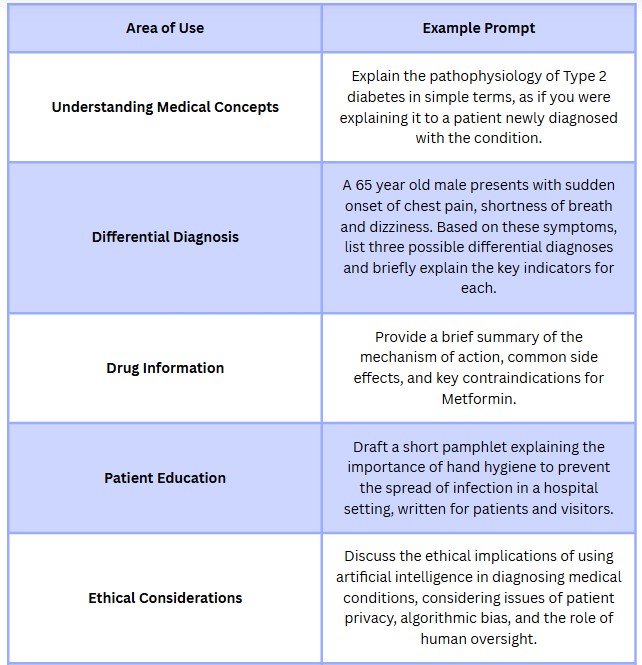
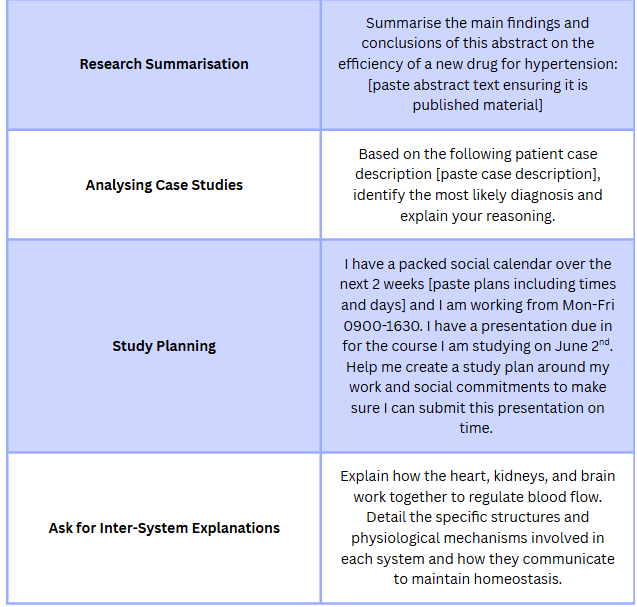
Fostering Critical Thinking & Digital Literacy
AI as a Tool, Not a Replacement: It’s crucial for students and professionals to view AI not as an autonomous intelligence, but as a sophisticated tool to augment human capabilities. Its purpose is to assist in tasks like information synthesis, idea generation, or drafting, thereby freeing up cognitive resources for higher-order thinking, analysis and problem solving. True mastery lies in leveraging AI to enhance, rather than replace, individual thought and original contribution.
Question AI Output: A fundamental aspect of digital literacy with AI is developing a sceptical, inquisitive mindset towards its output. Users must cultivate the habit of asking: “Does this make sense?”, “Is this accurate?”, “What evidence supports or refutes this claim?”, and “Is there another perspective?”. This continuous questioning ensures that AI-generated content is subjected to the same rigorous intellectual scrutiny as any other source.
Cross Reference and Verification: AI models, despite their sophistication, are prone to “hallucinations”—generating confident but fabricated information. Therefore, cross-referencing AI-generated facts with reputable, primary sources is non-negotiable. This verification process is critical to maintaining academic integrity and preventing the dissemination of misinformation, reinforcing the scholarly practice of evidence-based reasoning.
Identify Limitations and Biases: All AI models are trained on vast datasets, which inherently carry the biases and limitations of their source material. Educating users to identify potential biases (e.g., in language, perspectives, or omissions) and understand the scope of AI’s knowledge base is vital. Recognising these limitations allows for a more nuanced interpretation of AI’s output and prevents over-reliance or misapplication.
Recognise When Human Expertise is Necessary: While AI can process vast amounts of data, it lacks genuine understanding, ethical judgment, lived experience, and the capacity for true innovation. Users must be trained to discern situations where AI assistance is insufficient or inappropriate. This includes tasks requiring original critical analysis, subjective interpretation, ethical decision-making, empathetic communication, or complex problem-solving that demands human intuition and creativity.
Set Clear Guidelines and Boundaries with AI: Creating explicit guidelines and boundaries is essential for responsible integration into academic and professional contexts. This means clearly defining what constitutes permissible AI use (e.g., as a co-pilot for brainstorming or drafting) versus unacceptable practices (e.g., ghost-writing or plagiarism). Encouraging open discussions about plagiarism, authorship, academic integrity, and appropriate AI integration foster a culture of transparency and academic rigor. These conversations are crucial for developing shared understanding and ethical practices.
Data Privacy and Confidentiality: The handling of sensitive information when interacting with public AI models presents significant risks. It is imperative to educate individuals on the critical importance of data privacy and confidentiality. Uploading sensitive, confidential or patient-identifiable data into public AI models poses severe security and ethical breaches, which the user retains ultimate accountability for. Such models should only be used with non-confidential, anonymised or publicly available information, aligning with institutional data governance policies, legislation and professional ethics.

Critical Takeaway Points:
- Never put your own written assignments, unpublished literature, confidential or sensitive information into an AI tool.
- Always adhere to academic integrity guidelines from your academic institutions guidelines and policies.
- Experiment and grow together – Try different phrasing and techniques to see what works best.
- Be patient: AI models are constantly evolving, and sometimes it takes a few tries to get the desired output. The more you tell the tool and use it, the more it will learn and improve for next time.
- Understand Limitations: Always critically evaluate the AI’s output and make necessary revisions. It is not always right and sources are not always present. Always double check any critical information and ensure you and your students understand what information can and cannot be used with Gen AI tools.
Ultimately, AI is a powerful ally, and your ability to effectively communicate with it through well-crafted prompts is your superpower in the modern academic and professional landscape. It’s about empowering you to work smarter, think deeper, and achieve more. Embrace this tool, questions its output, and collaborate with it to elevate your impact.
What is your biggest challenge with AI prompting? Share your thoughts and experiences in the comments below, and don’t forget to grab your free Mastering AI Prompts Cheat Sheet to start crafting better prompts today!
DISCLAIMER
All views and opinions expressed in this post are solely my own and do not represent any organisation, including my employer. The educational practices and experiences discussed reflect my professional career to date, not exclusively my current role.
 The Educated Guess
Leave a comment